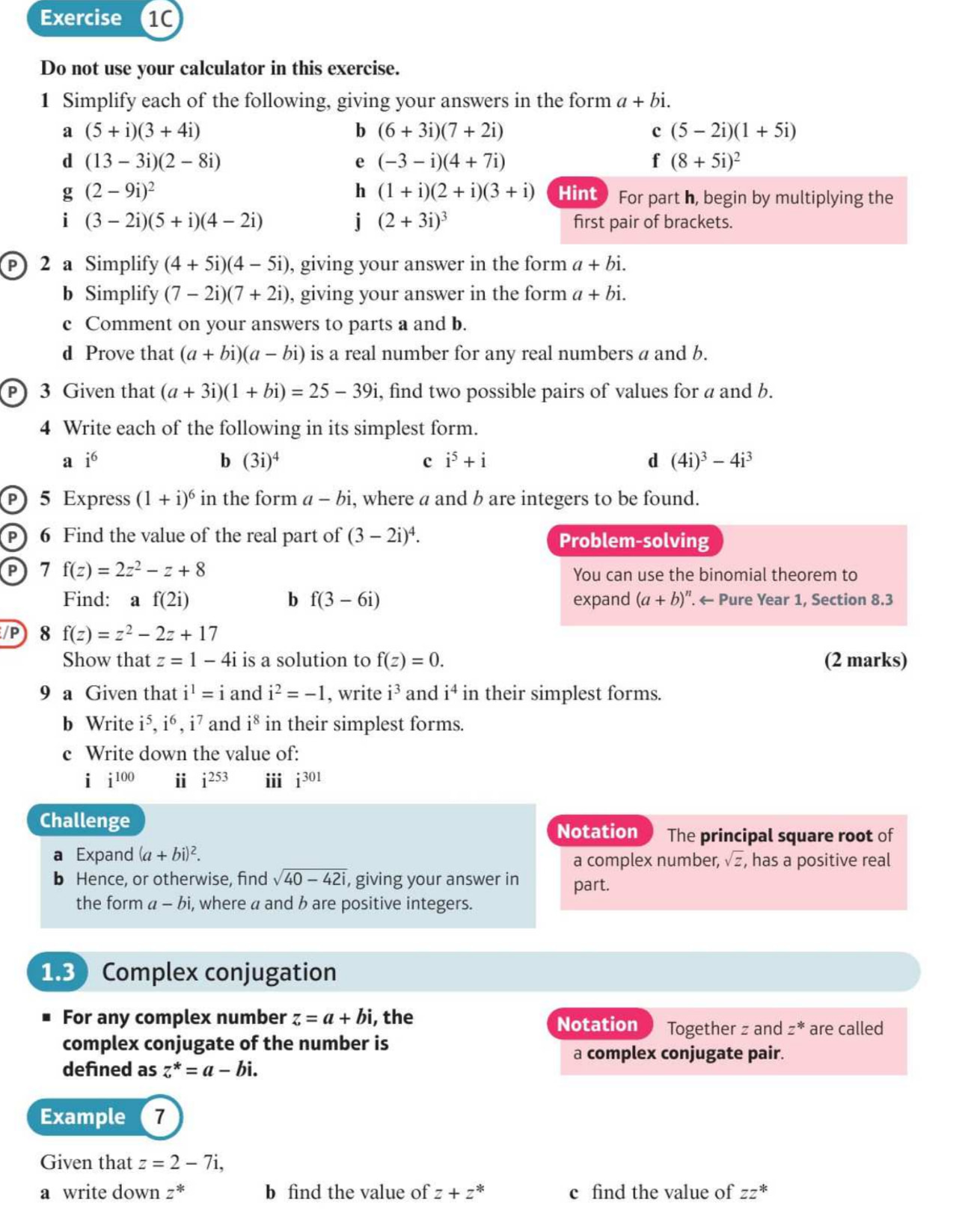

it’s really easy, you can do this yourself. but I’ll show you a little example
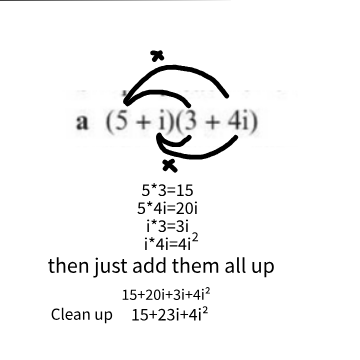
I like using the parrot beak version
you just take the first number in the first set of parentheses and multiply it with the ones in the second set of parentheses.
then do the same for the second number.
add them all up and simplify and there you go
to be fair, I didn’t specify what part I was talking about
I got to that bit (not on that specific q) but I was struggling to factorise to work out the answer on q3
got to 3bi(squared) + 42i +abi-25 = 0
how the hell am I meant to factorise that
Expanding with complex numbers is basically identical to expanding (ax+by)(cx+dy) and I’m guessing if you’re doing FM you’re pretty confident with this.
The one thing that’s different when you’re handling complex numbers is the nature of i, so of course wherever you have i^2 you’d replace that with (-1) since that’s how you define the complex unit. When you get onto higher powers (and what this means is covered a bit more later on in the course if you continue on to A2) there’s a cyclical nature so:
i^0 = 1
i^1 = i
i^2 = (-1)
i^3 = (-i)
i^4 = 1
… etc
give me a second to check this one out rq
I get the entire i thing, I’m just having problems factorizing (dang randomness, did you do fm?)
yeah
1 Like
looking at this abt to do hw of my own lmao
The issue I have is that this doesn’t address how to solve expressions like in part h of problem 1. How would you solve expressions like that?
I prefer using the grid method, you’ve just gotta expand it once like normal then expand it again using the 3rd part
What you can do is you can turn any number with ‘i’ parts in it into a complex number in the form x + yi by first calculating any powers of i and then factoring out the ‘i’ from any individual term with it in.
So
p + qi + 5i + 6
can become
p + 6 + qi + 5i
(p +6) + (q + 5)i
We call (p+6) the ‘real part’ and (q + 5) the ‘complex part’
I think this
3bi(squared) + 42i +abi-25 = 0
is almost correct, but I rather got an additional ‘a’ term
(a-3b-25) + (42 + ab)i = 0
but its been a couple weeks since I’ve done this so I might be rusty
From here, you need to consider the real part and complex part separately. Knowing that on the LHS you have a real part of (a-3b-25) and the RHS you have a real part of (0) we can write this as a - 3b - 25 = 0
And also with the complex part you have (42 + ab) on the LHS and (0) on the RHS. We can write this as 42 + ab = 0
And from there we have two simultaneous equations we can solve by substitution.
okay I think I got that right 
that might be a bit above my level
I’ve only done 2 fm lessons so far
thanks anyway, it’s helpful regardless
1 Like
I think I’ll be doing this stuff in a few weeks
Bookmarking this thread, these explanations might come in handy
1 Like
btw, use physicsmathstutor. the website is a godsend 

2 Likes
fr
was goated for my gcses too
wow that actually doesn’t look too difficult, though still above my paygrade atm.
i means square root negative one
(also regular maths is so much easier after fm)
The same way
(1+i)(2+i)(3+i) = 1×2×3 + 1×2×i + 1×i×3 + 1×i×i + i×2×3 + i×2×i + i×i×3 + i×i×i = 6 + 2i + 3i + i^2 + 6i + 2i^2 + 3i^2 + i^3 = 6 + 11i - 6 - i = 10i
sonion what is this black magic 
Can we go back to burning books and witches on same pits