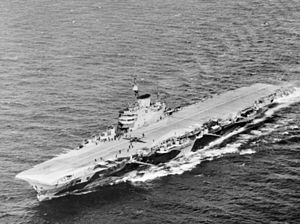
A WW2-era British aircraft carrier of the Implacable-class, she was completed in 1944 and took part in both the European and Pacific theaters of the war.
Design
Laid down on November 3, 1939.
Indefatigable was one of two ships her class, and carried an air wing of 81 planes. She was ordered by the Chamberlain government in 1938 in response to the rapid rearmament programs of Nazi Germany, and was supposed to be an improvement over the previous Illustrious-class carriers. She boasted slightly better speed and a larger aircraft capacity.
However, she was built under the terms of the Second London Naval Treaty, which ordered all ships constructed to be under 23,000 tons. As a result, protection and armor were sacrificed in order to achieve such improvements over her predecessors.
Indefatigable’s speed clocked in at 32.5 knots, but most of her armor stood at an unimpressive 2-4.5 inches.
Self-defence armament included the following:
- x8 dual-purpose twin 4.5 inch guns
- x5 anti-aircraft octuple 2-pounder “pom-poms”
- x1 anti-aircraft quadruple 2-pounder “pom-pom”
- x19 anti-aircraft twin 20mm Oerlikons
- x17 anti-aircraft single 20mm Oerlikons
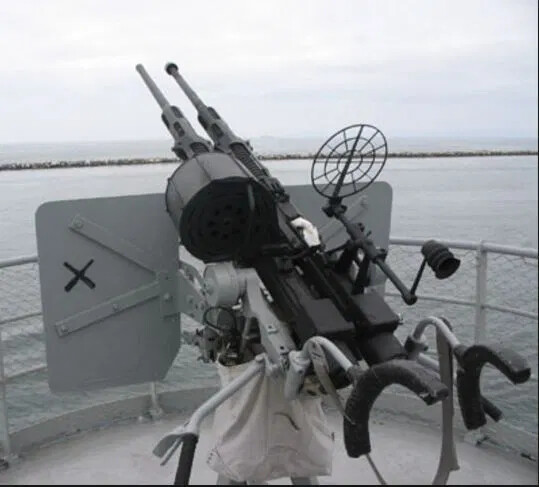
An example of an Oerlikon
Service Life
European Theater
Indefatigable’s career started off with humble transport shipping escorts in the North Sea. Her first combat mission involved participating in the sinking of German battleship Tirpitz on July 17, 1944:
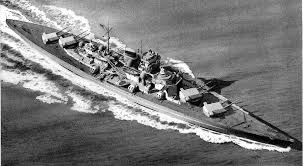
Multiple other carriers were present, and all launched their air groups when the Tirpitz was docked in Kaafjord, Norway during Operation Mascot. Indefatigable launched her Fairey Barracuda torpedo bombers along with a handful of Fairey Fireflies as fighter escorts. The bombers were to target the warship itself while the fighters strafed enemy ground AA defences.
The planes arrived at Kaafjord to find the site clouded with smoke projector, which prevented the British from even locating Tirpitz.
The strike was a failure and inflicted only minor damage to the mighty German battleship.
In Operation Goodwood, a similar attack was made using slightly different planes, but the mission yielded worse results than the last: a smoke screen covered the area again and no hits were scored at all.
Another attempt was made, but to no effect. A fourth mission was postponed due to bad weather, and fifth one caused only light damage. Indefatigable was then moved to the Far East, to face the ongoing war against Imperial Japan.
As for the Tirpitz, she was later finally sunk in November 1944 by Royal Air Force bombers.
Pacific Theater
Indefatigable arrived in Allied-control Ceylon (present day Sri Lanka) on December 10, 1944.
She was then paired up with fellow British carriers Indomitable and Victorious and carried out air strikes against a Japanese-held oil refinery in Sumatra on January 4th of the next year.
En route to Sydney, Australia, Indefatigable continued launching air strikes against refineries in Sumatra during Operation Meridian. The attack was deemed a success although with a heavy loss of planes and pilots. Indefatigable arrived in Sydney on February 10.
She then sailed North and linked up with the American 5th Fleet, bound for the Japanese Sakishima Islands. She was hit by a kamikaze (Japanese planes that damage enemy ships by suicide ramming) but stayed afloat. Her planes engaged enemy airfields on Formosa in late March but attrition was high and she was forced back to Leyte Gulf in the Phillipines for repairs and aircraft replacement.
Indefatigable was later moved back to Sydney and broke off from the British Pacific Fleet, which continued to wreck coastal Japanese targets throughout the summer of 1945.
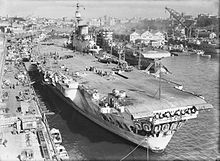
She reached the coast of Japan in late July and began bombing the regions near Osaka. The carrier delayed air strikes until August due to bad weather and the American nuking of Hiroshima. The atomic bombing was expected to bring the Japanese government to the negotiation table, but they refused to surrender, and Indefatigable resumed attacks against targets in Hokkaido in August.
The carrier then turned its attention to the Japanese capital of Tokyo, already shattered beyond recognition from American firebombing campaigns. A dive-bombing attempt was made against her after a peace treaty was signed by the Japanese, but missed and no damage was done.
She spent her postwar years as a tourist destination, transport ship, and training vessel. She was decommissioned in December 1946 and scrapped in September 1956.